Showing posts with label classic realism.keith gunderson. Show all posts

Thursday, January 14, 2021

The Expressive Figure 1_14_2021

 The Expressive Figure


Expressive Figure Assignment

Materials:

Hake Brush
Sumi Brush
Reed Pen
Sponge

Sumi Ink diluted 1:3 water

Sumi Ink Full Strength


Concept:
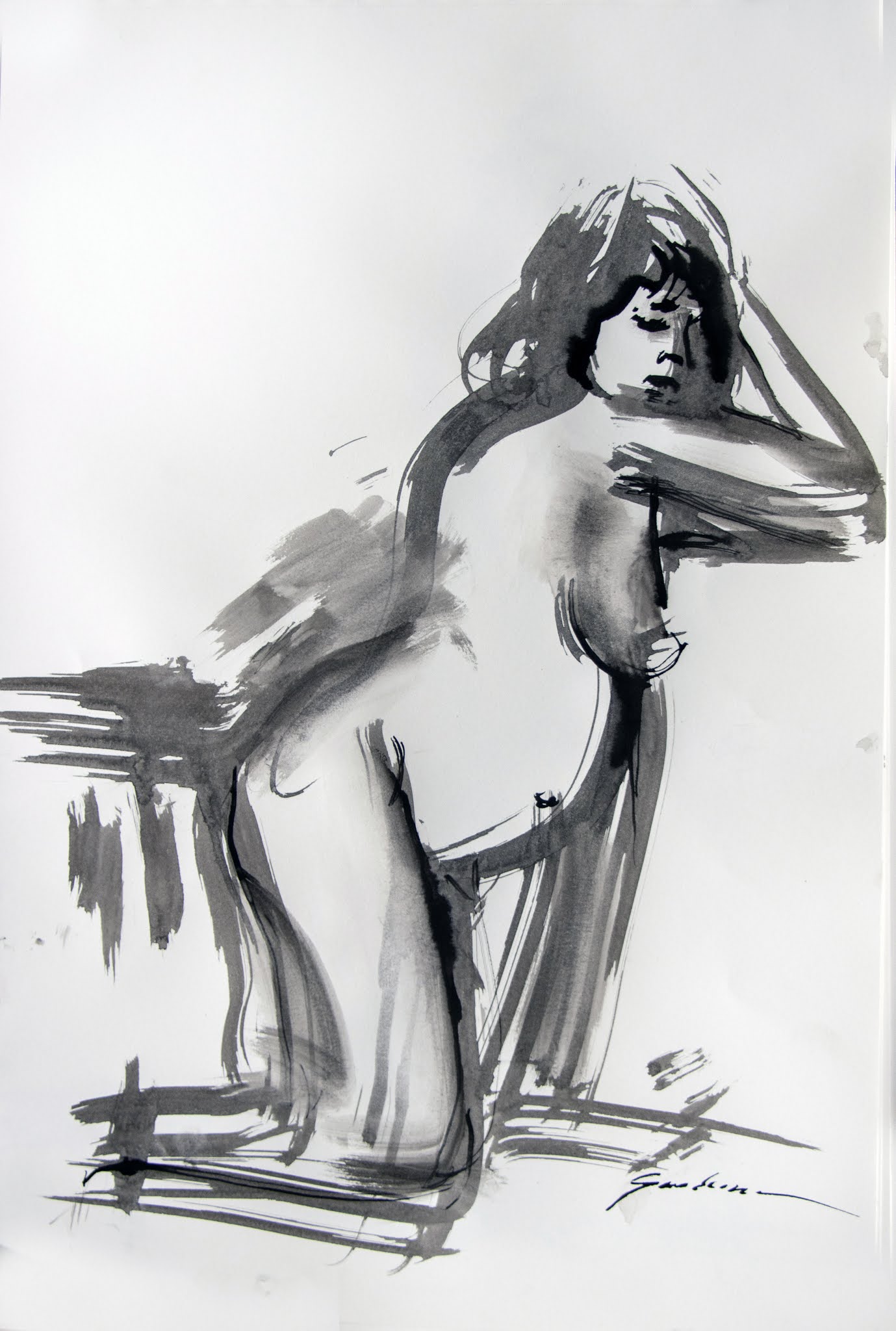
Using the Hake Brush , Sponge, Sumi, or similar equivalent imprecise brush, draw at least three selected poses only using a more precise tool ( Reed Pen, Squirrel Mop #2 or equivalent) for finishing details.

80% imprecise brush (Hake Brush)
20% precise brush (Sumi/Squirrel Mop)

Try to explore how the Hake brush creates a combing texture.


The Pregnant model.


Drawings for Reference


Sunday, May 20, 2018

Planes of the Head

Andrew Loomis Planes of the Head

From my workshop at the Woodstock School of Art

Here is Andrew Lommis' version of the Planes of the Head. There are many versions of the planar head which exist among them: the Asaro head, the Bridgeman head, etc. and I'll post versions of these here.  What these heads all have in common is that the artist is attempting to simplify the skull into more easily interpreted geometric planes. By simplifying the geometry, it enables the artist to better visualize how the skull occupies space and how light falls across it. The variations in the planarity among these artists interpretations reflect these artists own visualization of the skulls volumes.


Monday, January 16, 2017

From outline to spatial visualization


One visualization strategy is to conceptualize the figure as a mannikin rather than become too enamored of the anatomical details. A generalized approximation of geometry that resembles the masses of the figure emulates how the sculptor builds the volumes. For example, a peanut shape could be analogous with the torso, an ovoid for the head, cylinders for the arms and legs, etc.These primitive geometric forms are more easily mapped in the brain as we shall later find out, and create a volumetric placeholder which is ultimately more accurate than a finely placed contour.
What we are trying to train ourselves to see is the complete form in all its volumetric occupancy.
Illustrated here are CAD renderings of the human figure as groups of polygons that are "skinned" over a volume. From these renderings, it's possible to see more clearly the inner walls of the reverse side of the figure. Also noticeable is how the inner reverse wall exhibits the odd perceptual phenomena of appearing both concave and convex at the same time. Seeing through a wireframe CAD drawing or cross-sectioned rendering allows one to see the bi-symmetrically of the volume very clearly. In this example I sectioned a human figure into two halves along a natural lateral curve, dividing the figure into anterior and posterior halves. Separating the two halves it is possible to see the shell of the hidden back half of the volume.
The last picture illustrates the bi-lateral symmetry in action. I have duplicated the front half and mirrored its symmetry. By comparing the inner shell with the outer shell, it is virtually impossible to tell if the figure is convex or concave.


Convex or Concave???
Sunday, January 15, 2017

Origins of Contour Drawing


 The contour drawing defines the perimeter of the figure against its background, as so eloquently illustrated in the Durer engravings circa 1530 .Photographic realism before the camera often relied on the sight size execution as well as camera obscura and various grid transfer techniques. These are all forms of measurement that rely on the projection of a matrix grid that corresponds precisely with the image seen from one point of view, hence the stationary "eye pointer" that establishes the position of the viewer's eyeball.