Showing posts with label anatomy. Show all posts

Tuesday, May 2, 2023

The Expressive Figure 5_3_2023


The Expressive Figure Assignment


Concept: Value as Light and Form

Materials:

Materials
  •  Vine or Willow Jumbo Charcoal ( Generals), Graphite lead and holder, ballpoint pen, Crayon, etc
  •  90 lb drawing paper 12" x 19" or similar sketchbook
  •  Faber-Castell Kneaded Eraser
  •  I pad


Starting with charcoal or graphite, quickly sketch and draw a gestural mannikin of the pose with an emphasis on proportions and action. This should take fifteen seconds or less and be in the spirit of what Michelangelo called "the Flame". Think of it as three helixes wrapping around a central core, like ribbons or strands of flame rising and converging above.
With the template of the mannikin pose as a guide, consider how the volumes of the "peanut", "cylinders, and "ovoid" describe the volumes "in space" and can taper as they move away from us and loom larger the closer they are to us. Be cognizant of this "in and out" spatial occupancy.

Visualize the medial line as a sagittal section through the human figure. On either side of this section is another complete "half-section" - a mirror of itself, and as such recedes back into space away from us. The entire right arm behind the neck moves off into the distance as demonstrated here.


Wednesday, January 25, 2023

The Expressive Figure 1_25_2023


The Expressive Figure Assignment

Concept: Composition of Positive and Negative Space

Figure/Ground Figure and Flux
Materials
  •  Vine or Willow Jumbo Charcoal ( Generals), Graphite lead and holder, ballpoint pen, Crayon, Acrylic Paint Marker etc
  • White or Ivory Pastel pencil or chalk, NuPastel Ivory 279
  •  90 lb drawing paper 12" x 19", Canson Mi Tientes toned paper or similar, sketchbook


The exercise focuses on the figure-ground relationship, that which is defined within the parameters of the figure shape and that which is defined by everything that is NOT defined by the figurative shape. This negative shape (as defined by the contour) is the ground or more accurately "the Flux". Placem


George Platt Lynes


Joseph Sheppard


Tuesday, January 17, 2023

The Expressive Figure 1_18_2023


The Expressive Figure Assignment

Concept: Stereoscopy and Neural Net

The Gestalt of perceiving the whole from the parts
Materials
  •  Vine or Willow Jumbo Charcoal ( Generals), Graphite lead and holder, ballpoint pen, Crayon, etc
  • White or Ivory Pastel pencil or chalk, NuPastel Ivory 279
  •  90 lb drawing paper 12" x 19", Canson Mi Tientes toned paper or similar, sketchbook
  • Grid paper is also recommended for this exercise.


Starting with charcoal or chosen media, quickly indicate the gestural action of the pose with an emphasis on the placement of the figure on the paper. Use a descriptive scribble line with a light touch so that the values are not too dark. Once you establish the mass of the figure, using the same light touch, extend horizontal lines across the page that correspond with the crotch height from the floor as well as the shoulder height from the floor. If you like, you can also create a subset of horizontals that correspond to the height of the knees and elbows as well as the top of the cranium from the floor.
Draw multiple views of the figure from your fixed point of view, aligning the anatomy to the horizontal matrices. Your brain is processing the binocular vision into a 3D "experience". Also, from a figurative artist's point of view, the hidden volumes of anatomy that are unseen, become apparent as the model rotates and "fill out" the volume. 

Gestalt of Perception

The human brain is exceptionally good at filling in the blanks in an image and creating a whole that is greater than the sum of its parts. It’s why we see faces in things like tree leaves or sidewalk cracks. This principle is one of the most important underlying ideas behind the gestalt principles of perception. The most influential early proposal written about the theory was published by Max Wertheimer in his 1923 Gestalt laws of perceptual organization, though Wolfgang Köhler’s 1920 discussion of Physical Gestalten also contains many influential ideas on the subject. 
In the simplest terms, gestalt theory is based on the idea that the human brain will attempt to simplify and organize complex images or designs that consist of many elements, by subconsciously arranging the parts into an organized system that creates a whole, rather than just a series of disparate elements. Our brains are built to see structure and patterns in order for us to better understand the environment that we’re living in.
There are six individual principles commonly associated with gestalt theory: similaritycontinuationclosureproximityfigure/ground, and symmetry & order (also called prägnanz). There are also some additional, newer principles sometimes associated with gestalt, such as common fate.


For your consideration:


Thursday, October 14, 2021

The Expressive Figure 10_14_2021


The Expressive Figure Assignment


Concept: Lost Edges and Turning Plane


Materials:

Technique One
  •        Vine or Willow Jumbo Charcoal
  •         90 lb drawing paper 12" x 19" or similar
  •        Faber-Castell Kneaded Eraser"


Starting with Vine or Willow Charcoal, lightly draw a gestural mannikin of the pose with the emphasis on proportions and action.
With the template of the manniken as a guide, scribble a dense tangle of lines to describe the mass of the figure, gradually decreasing the pressure and density as you move out to the edges. 
To explore the lost edges, draw another figure with a gestural manniken very lightly to function as a template as described before. This time create a contour line that describes the edges of the figure. Then, using an eraser or simply by smudging, calibrate edges to be either lost or found, based on if that form turns toward you or away.
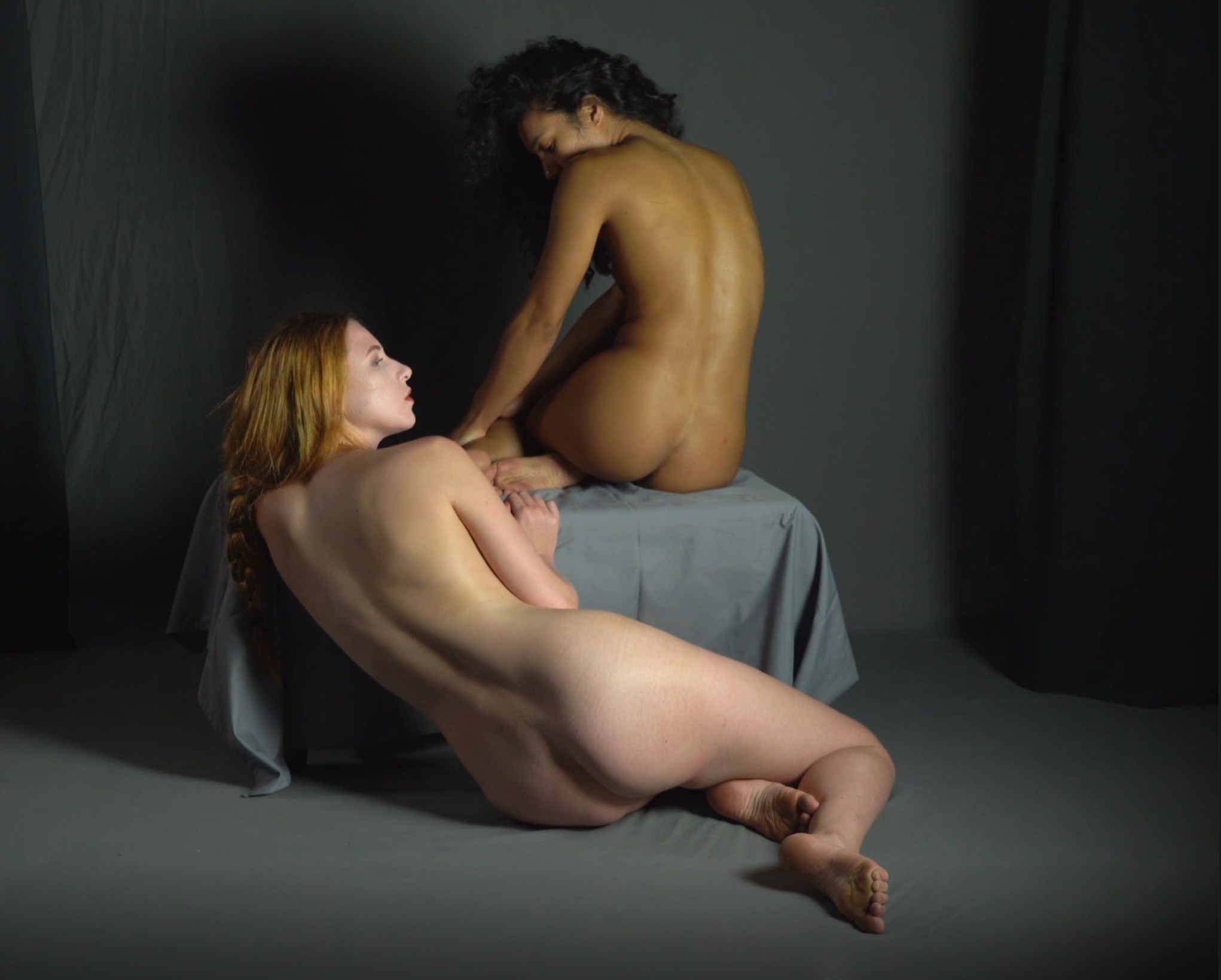
For a couples/Shunga exercise, draw two figures together, either with arms wrapped around each other or touching., with specual emphasis on how the figures arma/limbs are decribing the occupancy of space of the other.
Draw at least three poses using either technique - more if you feel so inclined.


Thursday, January 14, 2021

The Expressive Figure 1_14_2021

 The Expressive Figure


Expressive Figure Assignment

Materials:

Hake Brush
Sumi Brush
Reed Pen
Sponge

Sumi Ink diluted 1:3 water

Sumi Ink Full Strength


Concept:
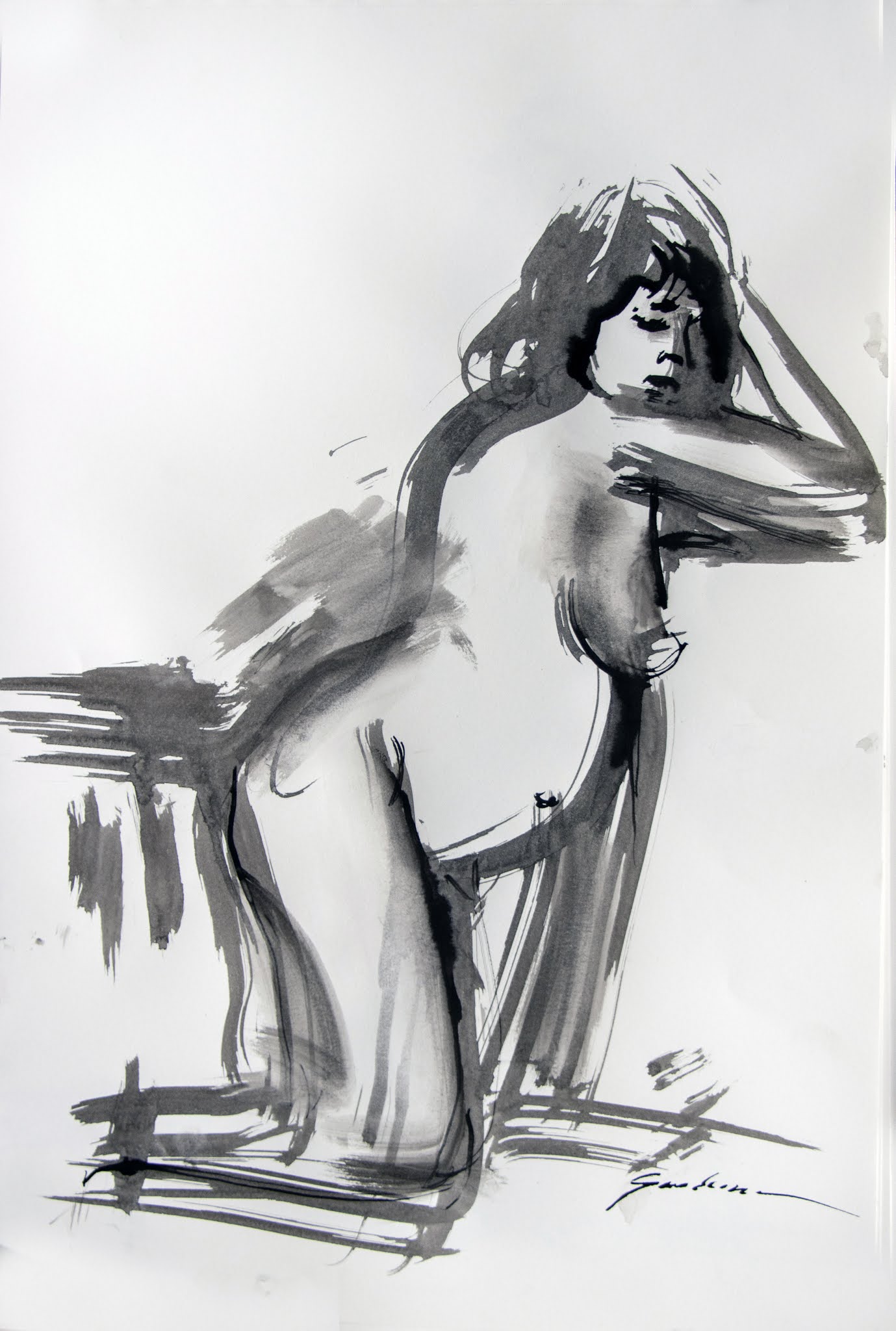
Using the Hake Brush , Sponge, Sumi, or similar equivalent imprecise brush, draw at least three selected poses only using a more precise tool ( Reed Pen, Squirrel Mop #2 or equivalent) for finishing details.

80% imprecise brush (Hake Brush)
20% precise brush (Sumi/Squirrel Mop)

Try to explore how the Hake brush creates a combing texture.


The Pregnant model.


Drawings for Reference