Sunday, May 20, 2018

Planes of the Head

Andrew Loomis Planes of the Head

From my workshop at the Woodstock School of Art

Here is Andrew Lommis' version of the Planes of the Head. There are many versions of the planar head which exist among them: the Asaro head, the Bridgeman head, etc. and I'll post versions of these here.  What these heads all have in common is that the artist is attempting to simplify the skull into more easily interpreted geometric planes. By simplifying the geometry, it enables the artist to better visualize how the skull occupies space and how light falls across it. The variations in the planarity among these artists interpretations reflect these artists own visualization of the skulls volumes.


Drawing the Head

Drawing the Head

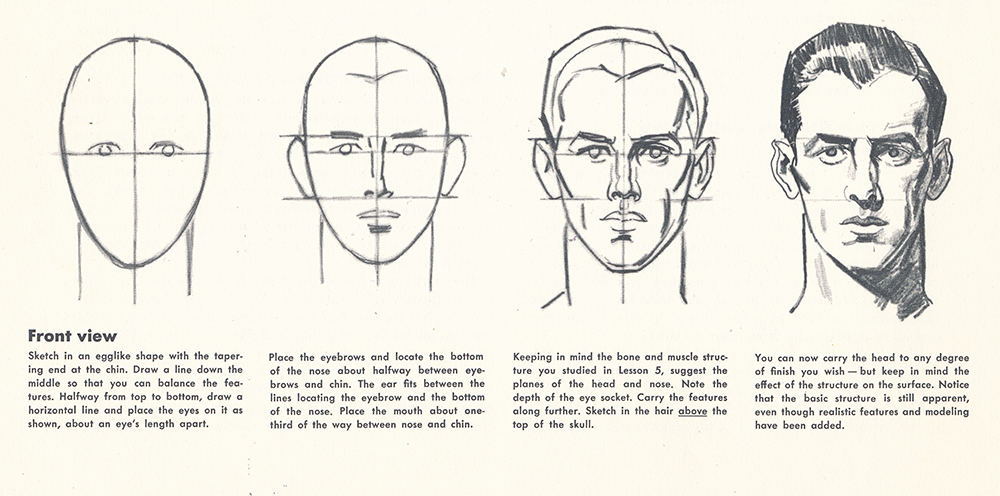
This is a compendium to my Drawing the Head Workshop  which was held at the Woodstock School of Art on May 8th and 9th 2018. I used as a syllabus, elements of the Famous Artists Course 1957 version. I believe the illustrations and text are by Albert Dorne who along with Norman Rockwell founded the Famous Artist Corse.

I've added my own observations to this course outline, which rely explicitly on the Medial Line as being the foundation from which drawing the head becomes much easier.


Sunday, February 5, 2017

Hatching with Frederick Goltzius


Hendrick Goltzius was a German-born Dutch printmaker, draftsman, and painter. He was the leading Dutch engraver of the early Baroque period, noted for his sophisticated technique and the "exuberance" of his compositions. According to A, Hyatt Mayor, Goltzius was the last professional engraver who drew with the authority of a good painter, and the last who invented many pictures for others to copy".
According to Samuel van Hoogstraten, a student and biographer of Rembrandt, it was the master himself that encouraged his students to copy Goltzius engravings as a way to learn how to hatch.


Hatching with Robert Crumb


Illustrated here are various styles of hatching. Some are combinations of hatching techniques distributed to create contrasting effects. In the work of Robert Crumb, for example, the artist hatches a background with perpendicular fine cross hatching and contrasts this with and area of contour hatching, implying different textures. The masterful use of the contrasting hatching textures can create great luminosity and imply color.


Saturday, February 4, 2017

Hatching Topologies for the Artist


A methodology of drawing that emerged over the years as a way to describe form is known as hatching. Hatching is used as a way to organize lines to better communicate the concept of form to the viewer. Hatching is a kind of drawing language, comprised of groups of lines of varying lengths, that often appear as a series of parallel lines which describe the topology of the form in space. Hatching can also be a pattern of shapes that through proximity to one another create the illusion of light on an object- commonly referred to as the light model. All forms of hatching rely on patterns of alignment and orientation to describe how form reflects light thereby creating in the viewer's brain information about how that object occupies space. In this regard, hatching is very much like the matrix of polygons that describe a volume in CAD space, as demonstrated in previous posts.
As a primer, one might consider that there are six types of Hatching modalities.


Contour Hatching


Parallel Hatching


Cross Hatching


Fine Cross Hatching 


Tick Hatching


Basket Hatching

Wednesday, February 1, 2017

Topological strategies of Antony Gormley


These visual metaphors help us to visualize the volume of a figure by creating a virtual manikin in space. We are then able to transduce the visual information into a drawing or painting with a greater sense of that figure's occupancy of space. Consequently, the artist is then less dependent on measuring the contours of the image on the canvas because they can "project" a holographic facsimile of the volume with their visualization skills. 
One example of this is the work of Antony Gormley. The British sculptor fills the volumes of his figures with various forms that range from cubes to tangled wires, to colossal steel grids.Gormley can "see" the human form in space- he senses it's occupancy and displacement. This gives him free reign to experiment with all kinds of materials with which to describe these volumes.